 +91-7777914841
 visa@agileconsultancy.com
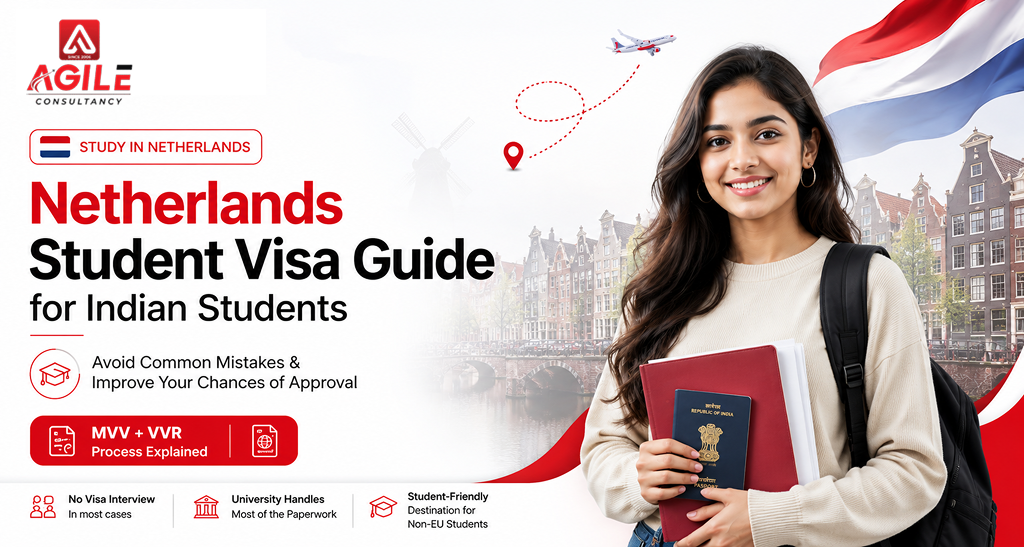
Most Netherlands visa rejections are not about complex rules. They happen because students go in without a clear picture of how the process actually works.
Here’s the good news: if you meet all eligibility requirements, submit accurate documents, and follow the process correctly, you can achieve a 100% successful visa application outcome. In most cases, there’s no visa interview, and your university handles a significant portion of the paperwork, making the Netherlands one of the most student-friendly destinations for non-EU students.
FIRST: WHICH VISA DO YOU NEED?
It depends on how long your course is.
- Under 90 days (summer school, short exchange): A standard Schengen visa via VFS Global. Processed in 15–45 days.
- Over 90 days (Bachelor’s, Master’s, PhD): You need the MVV + VVR — the long-stay path. This is what most Indian students require.
- Timeline: IND takes up to 60 days to decide. Add embassy appointment time and document prep — start at least 3–4 months before your course begins.
DOCUMENTS YOU CAN’T AFFORD TO GET WRONG:
| Document | Key Requirement |
| Valid Passport | Minimum 12 months validity from application date |
| Admission Letter | From an IND-recognised Dutch institution — check for stamps and signatures |
| Proof of Funds | Bank statements for last 3–6 months — consistent balance, not a sudden spike |
| Health Insurance | Valid in the Netherlands, minimum €30,000 medical coverage |
| Academic Transcripts | All degrees, translated into English if needed |
| Language Score | IELTS 6.5+ or TOEFL (required by most Dutch universities) |
| Passport Photo | 35mm x 45mm, white background, taken within 6 months |
HOW MUCH MONEY DO YOU NEED TO SHOW?
The Indian needs proof of €1,094–€1,250 per month for living costs, roughly around €13,000–€15,000 for a full year, not including tuition.
Acceptable sources: your own bank account, a parent/sponsor with salary slips and Income Tax Report, a scholarship letter, or an education loan approval.
- Watch out: A bank account that suddenly jumps from ₹5 lakh to ₹35 lakh two weeks before submission is a big red flag. IND looks for a consistent financial history, not a last-minute top-up.
THE FOUR COMMON REASONS DUE TO WHICH APPLICATIONS FAIL:
1). Incomplete or inconsistent documents
A missing signature or mismatched bank figures gives the officer reason to reject. Check your file twice — then have someone else check it.
2). Weak financial proof
Insufficient or unclear funds is the single biggest rejection reason across European student visas. Build your bank balance early, keep statements stamped and updated.
3). Wrong or inadequate health insurance
The cheapest policy isn’t always the correct one. Confirm it covers a minimum of €30,000 medical expenses and is valid specifically in the Netherlands.
4). Applying too late
IND alone takes 60 days. Students who start 6 weeks before their course date almost always run into problems. Three to four months of runway is the minimum.
AFTER YOU LAND: WHAT HAPPENS NEXT
- Register with your gamete (municipality): Within 5 days of arrival.
- Collect your VVR residence permit: Your University arranges this. Takes about 2 weeks.
- Get your BSN (Citizen Service Number): Needed for banking, insurance, and work contracts.
- TB test: Mandatory for Indian nationals — done within 3 months of arrival.
READY TO APPLY? TALK TO US FIRST
The Netherlands process is genuinely manageable if you go fully prepared. At Agile Consultancy, we’ve helped hundreds of Indian students navigate exactly with this and secured 100% success rate from shortlisting universities to visa submission to post-arrival support. We handle the confusing parts so you can focus on getting ready to study.